Savasana is often treated as the dessert at the end of a yoga class — a brief nap after the "real" work is finished. Students reach for their sweaters, wiggle around until they find a tolerable position, and then wait for the lights to come up again. But in classical yoga, the pose of the corpse is not an afterthought. It is the point. It is meant to be so much more.
To lie down like a dead body — motionless, surrendered, unguarded — is a radical invitation in a culture that measures the value of a life by its output. Savasana asks nothing of us except honesty. It invites us to stop striving, stop fixing, stop becoming, and instead experience what remains when doing falls away. In that falling away, we encounter something subtle: the truth that death is not a separate continent we will one day arrive at, but a country whose borders we touch each time we exhale.
In Savasana: Between Breath and Death, written with longtime teacher Richard Rosen, we explore the pose from multiple angles — its long history, its practical "how to" for students and teachers, and its deeper role as both a rehearsal for dying and a rehearsal for living. The practice of this pose resonates with those who accompany others through loss and dying, reminding us that letting go is not only the work of the dying. It is also the work of the living.
Savasana, the corpse pose, belongs to a long lineage of threshold practices. In yoga tradition, thresholds are sacred because they mark transition: between night and day, house and street, inhale and exhale, life and death. The pose honors that liminality. It lives in the narrow gap between effort and surrender.
There is a beautiful alignment here with the work of death doulas. To accompany someone across the threshold of dying is to witness their gradual loosening from the world of roles, stories, obligations, and identities — the small "I" that insists on continuity even as the body prepares to release it. Doulas know this terrain intimately: the territory of un-becoming, un-doing, un-holding.
In savasana, this loosening happens symbolically. The practitioner lies down and lets the body become still. The mind, restless, managerial, and anxious to organize experience often protests at first. Over time, the stillness settles us from the outside in and the inside out. Thoughts and emotions quiet down. The senses withdraw. The boundary of "I" softens.
It is not that savasana imitates dying; it is that dying and savasana share a surrender and letting go.
In the Buddhist lexicon, the space between death and rebirth is called the bardo — a liminal interval between worlds. Tias Little, who wrote the foreword to our book, describes savasana as a bardo as well: the body inert, the mind alert, the atmosphere thinned to something otherworldly.
To lie down like a dead body — motionless, surrendered, unguarded — is a radical invitation.
Those who have sat at the bedside of the dying know that bardo feeling. Time thickens. The air changes. Speech becomes whispers, then gestures, then breath. The dying person's world narrows until it is composed of only what matters, hopefully that love is what matters most.
Savasana offers a rehearsal for that narrowing. The mind begins with a hundred preoccupations, then forty, then three. Eventually even the categories fall away. At a certain point in my own practice, the personal pronoun dissolves, "I am" becomes simply "am-ness." A lightness, a spaciousness, a sense of at-one-ness. The yogic texts call this witness consciousness. In our book, we describe it as the moment when the self stops grasping itself.
This witnessing is also what doulas do. They witness without intervening. They make space without filling it. They accompany without directing. Savasana can teach this kind of presence: presence without agenda, presence without strategy — a rare gift in modern life and an essential one at the end of it.
Most of us don't fear physical death as much as we fear the pain of dying and the erosion of identity. Who am I without my name, my house, my career, my children, my obligations, my memories? Who am I if I can no longer play the roles that once defined me?
In savasana, we practice a little of that dissolution. The roles and narratives we cling to loosen, not because they are bad, but because they are temporary. The yogis sometimes call these "micro-deaths." The death of self-image. The death of certainty. The death of control.
As we age we often experience these micro-deaths long before our final breaths. Spouses become caregivers, children become guardians, autonomy becomes dependence, and the social masks that served us up until then fall away. The body teaches us what the mind cannot imagine: that letting go is not a failure, but a passage.
Savasana prepares us for that passage by letting us taste a sliver of it now — in safety, in stillness, in breath.
The yogic premise is simple: practice dying before you die. Not as a morbid exercise, but as a way of loosening the grip of fear. What we refuse to look at grows monstrous. What we turn toward becomes bearable.
When I first began to teach savasana, I noticed that students had trouble being still — not because their bodies couldn't manage it, but because stillness confronts us with ourselves. We prefer distraction, productivity, busyness, scrolling, noise — anything that keeps us from the quiet territory where truth accumulates.
The dying do not have this luxury. As the body weakens, so does the infrastructure of distraction. What remains is presence. And presence, when met with compassion, becomes its own form of grace.
In savasana, we rehearse that grace. We soften the body toward the floor the way the dying soften toward the bed. We breathe into the unknown rather than contracting against it. We allow our thoughts to settle like silt in the riverbed of consciousness. We practice being carried.
If savasana teaches us how to die, it also teaches us how to live — with less pretense, more tenderness, and a deeper reverence for the ordinary.
When we turn toward death, life becomes vivid. Our priorities rearrange. What once felt urgent reveals itself as trivial. The small joys — a hand on the arm, a cup of tea, a quiet afternoon, a breath that arrives and leaves without effort — feel suddenly immense.
 Presence, when met with compassion, becomes its own form of grace.
This rearrangement is also familiar to doulas and hospice staff. Many have watched a dying person awaken to the beauty of the final days: the way light falls across a pillow, the softness of a beloved's voice, the simple mercy of breath. The dying often become our teachers, reminding us that life was never measured by accumulation but by presence.
Savasana offers this reminder daily. The pose ends, we sit up, we return to the world changed — if only slightly. Over time, those slight changes accumulate. We become less reactive. Less defended. More curious. More compassionate. More willing to look directly at what is.
One day, we will all lie down and not rise again. This ultimate savasana is not a metaphor. It is a fact. The question is not whether we will die, but whether we will meet death as strangers or as acquaintances.
To practice savasana is to make the acquaintance now, in tiny, gentle increments. To learn the art of letting go before we are required to perform it in full. To prepare for the moment when our breath becomes the threshold between the known and the unknowable.
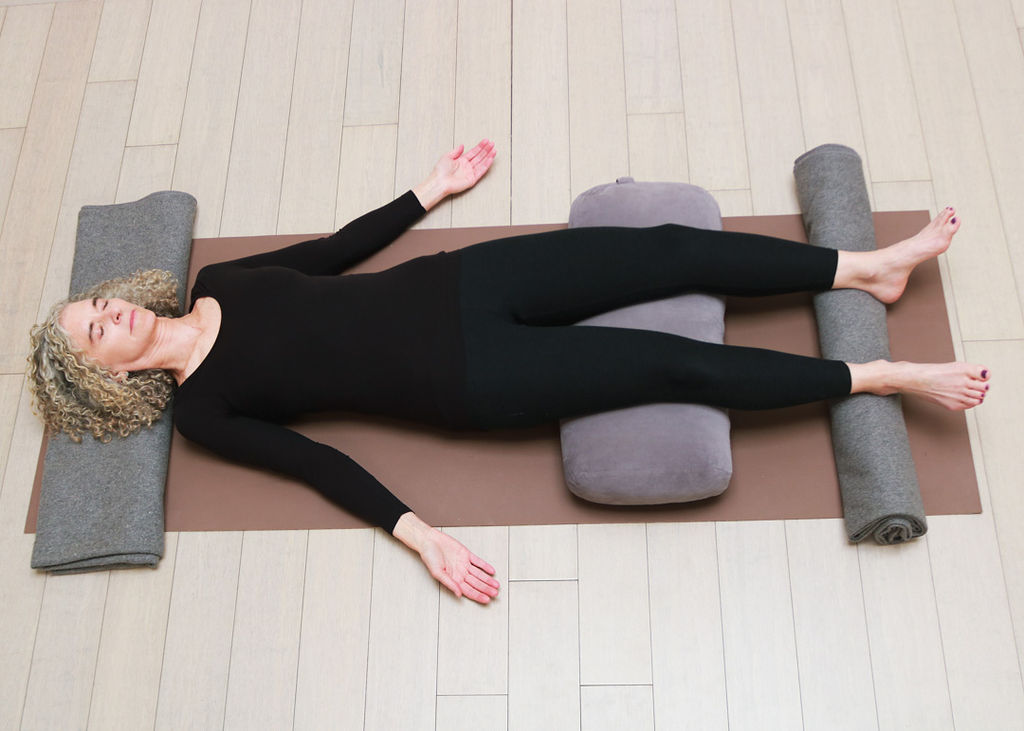 Basic Savasana
Basic Savasana
Lie on your back with a blanket under the head, a bolster under the knees (a pillow or rolled towel works too), and a rolled blanket or towel under the achilles tendon. Arms should be placed a few inches from your sides with palms facing up. Watch the breath and pause for an extra second at the base of the exhale. Allow the body to soften and the mind to settle.
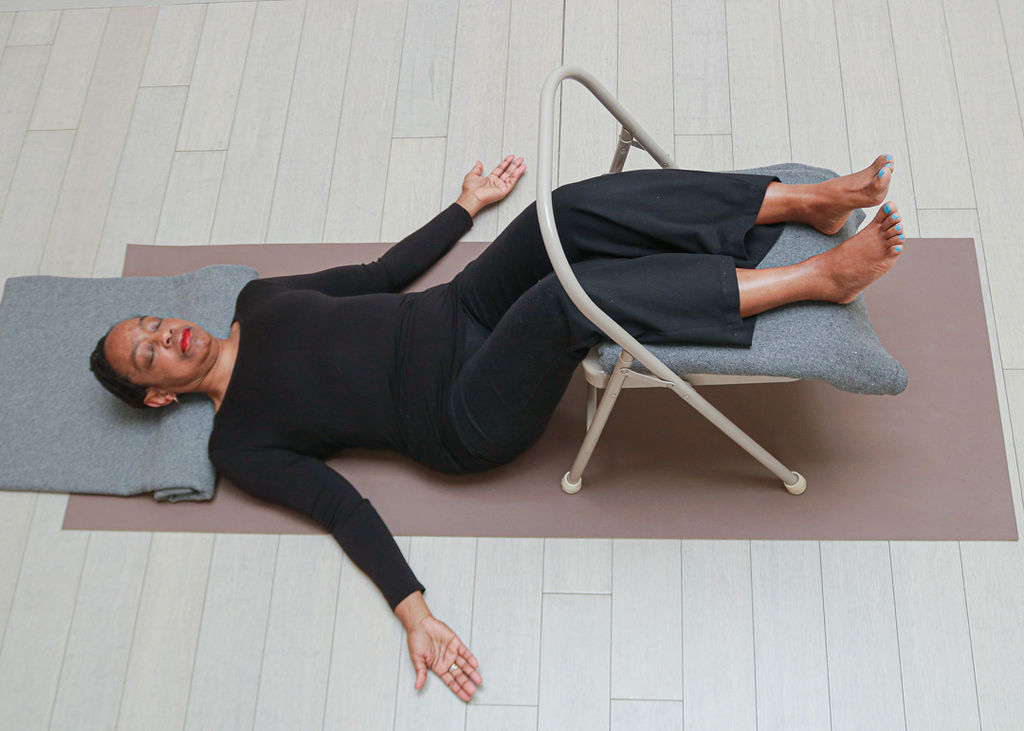 Savasana with calves on chair
Savasana with Calves on Chair
A great option for folks with any kind of lower back pain. Lie on your back with a blanket under the head and the entire back of the calves resting on a chair seat. You may want to put padding on the chair seat depending on the chair you use. Let the arms rest a few inches from your sides, palms up. Focus on your breath for a few minutes and allow the whole body to release into stillness.
Practicing the Pose: A Guide to Letting Go
Lie down in savasana and allow yourself 10–15 minutes for this practice of conscious release.
1. Settle into stillness
Lie on your back. Let your body become heavy against the earth. Arms rest a few inches from your sides, palms open to the sky.
2. Watch the breath
Don't change it. Simply witness the inhale arrive, the exhale depart. Notice the small pause at the bottom of each breath — the threshold between breaths.
3. Release the body, piece by piece
Let the weight of your head sink into support. Soften your jaw, your tongue, the tiny muscles around your eyes. Feel your shoulders melt away from your ears. One by one, release your grip on each part.
4. Let thoughts pass like clouds
When the mind reaches for planning, remembering, solving — simply notice. You don't have to follow. Let each thought drift by without grasping.
5. Dissolve the boundary of "I"
As you settle deeper, notice where your body ends and the floor begins. Let that edge soften. You are being held. You are being carried.
6. Rest in what remains
Beyond doing, beyond becoming — what's here? Stay with that spaciousness. This is the practice of letting go while still breathing.
When you're ready to return, wiggle your fingers and toes. Roll to one side and rest there. Then slowly press yourself up to sitting. Notice how you feel.
About the author
Leslie Howard is an Oakland-based yoga educator specializing in pelvic health and sacred rest. With over 3,500 hours of study and decades of teaching
experience, she has led two yoga studies at UCSF, authored Pelvic Liberation, and trained as a death doula. She hosts community Death Cafés,
volunteers for hospice with Kaiser, and advocates for conscious dying and deep rest in contemporary yoga.
Website:
www.lesliehowardyoga.com
Featured book
Savasana: Between Breath and Death (co-authors Richard Rosen and Leslie Howard) explores yoga's most overlooked pose not as a nap,
but as a path to radical rest, spiritual surrender, and conscious dying. The book blends yogic wisdom, science, and death awareness to reframe how we rest,
how we teach, and how we die with greater presence and grace.
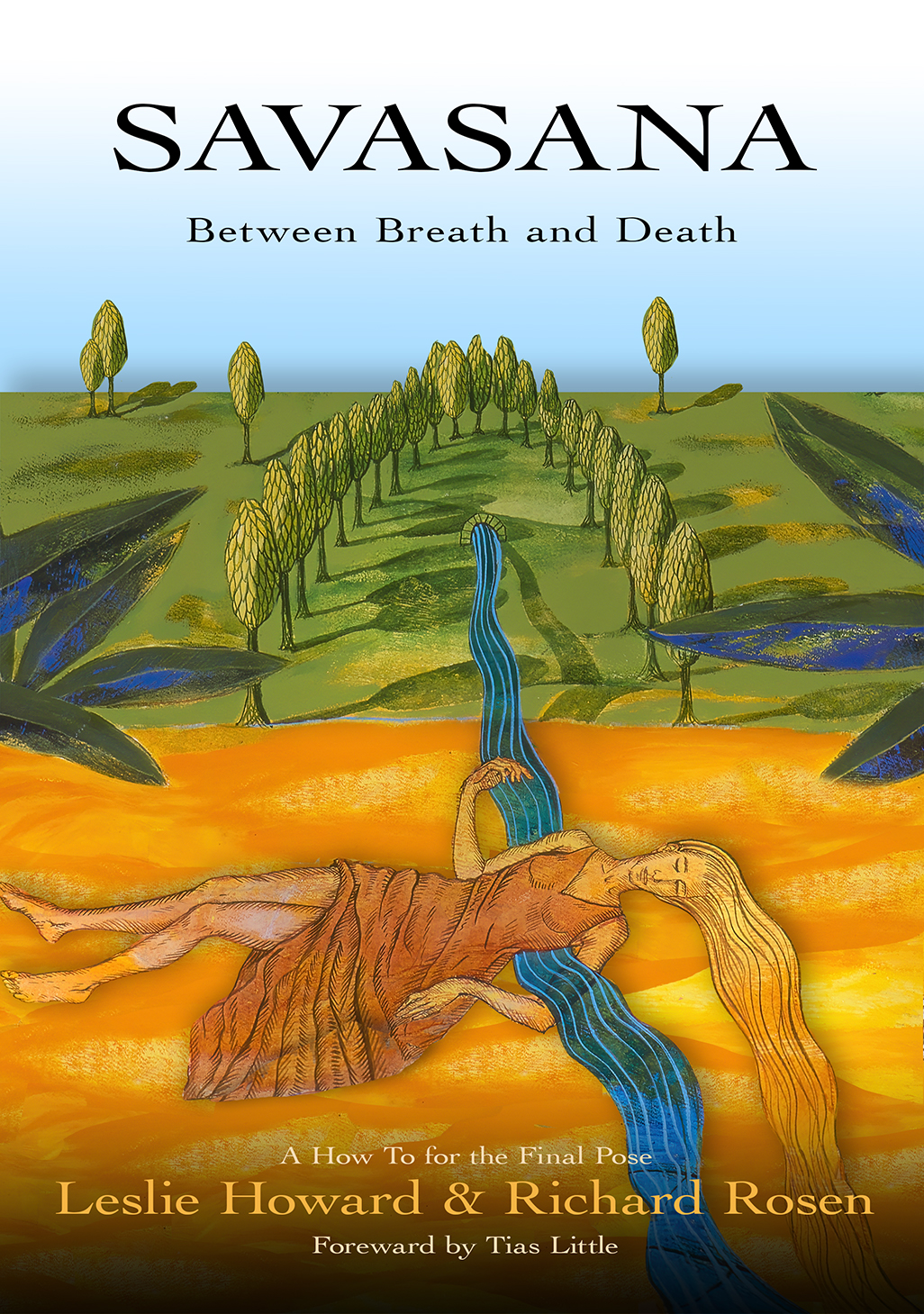
"Howard and Rosen invite readers to explore how practicing savasana opens a pathway to insight within the body and mind, granting access to a deeper awareness of mortality and meaning that we can carry off the mat and into life."
— Francesca Lynn Arnoldy, Kindred Grief Care and Cultivating the Doula Heart